
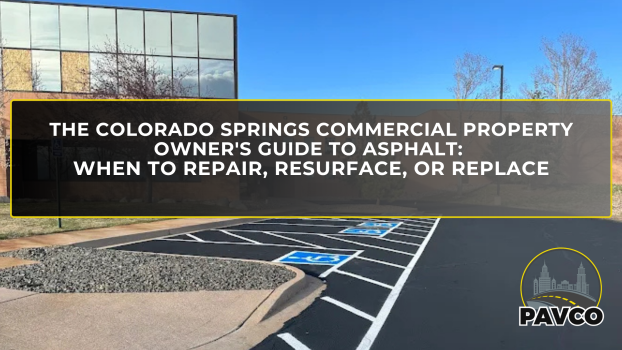
If you manage a commercial property in Colorado Springs, your parking lot and pavement take a beating that property owners in most other parts of the country never have to think about. Freeze-thaw cycles that can swing 50 degrees in a single day. UV exposure intensified by high-altitude sun. Heavy snow removal equipment dragging across the surface all winter. Ice melt chemicals working their way into every small crack they can find.
The result is that Colorado Springs asphalt ages differently than asphalt in milder climates. It deteriorates faster in some ways, holds up better in others when properly installed, and demands a more proactive maintenance strategy than most property owners realize until the damage is already done.
The most common question we hear from commercial property owners and managers in the area is some version of the same thing: Do I need to repair this, resurface it, or just replace the whole thing? It is a fair question, and the answer depends on more than just how bad it looks. It depends on what is happening beneath the surface, how old the pavement is, what kind of traffic it handles, and what your long-term goals are for the property.
This guide walks you through every option in plain terms so you can make an informed decision before calling a contractor so you know exactly what questions to ask when you do.
Why Colorado Springs Is Uniquely Hard on Asphalt
Before getting into repair options, it helps to understand what your pavement is actually up against. Colorado Springs sits at roughly 6,000 feet above sea level, and the local climate creates conditions that accelerate pavement wear in ways that catch a lot of property owners off guard.
The biggest culprit is the freeze-thaw cycle. When water infiltrates small cracks in asphalt and then freezes, it expands by about nine percent. That expansion puts enormous pressure on the surrounding pavement, widening the crack and weakening the base beneath it. In Colorado Springs, this cycle can repeat dozens of times in a single winter and even in shoulder seasons when daytime highs push above freezing before temperatures drop again overnight.
UV radiation is another factor that does not get enough attention. At 6,000 feet, there is significantly less atmosphere filtering out ultraviolet light. Over time, UV exposure oxidizes the asphalt binder that holds the surface together, causing it to become brittle, fade from black to gray, and crack more readily under traffic and temperature stress.
Add in the mechanical wear from snow plows, the chemical damage from de-icing salts and ice melt products, and the heavy vehicles common on commercial properties, and you have a combination that demands more regular attention than standard maintenance schedules might suggest.
The good news is that well-installed, properly maintained asphalt in Colorado Springs can still last 15 to 25 years. The key is knowing when to intervene and how to time it right.
Understanding Your Asphalt’s Lifecycle
Asphalt pavement does not fail all at once. It deteriorates in stages, and identifying which stage your pavement is in is the starting point for figuring out the right solution.
Stage 1: Good condition (Years 0 to 5): New or recently maintained asphalt. Surface is dark, smooth, and flexible. Minor surface cracking may begin to appear toward the end of this stage. Sealcoating during this window is the best preventative investment you can make.
Stage 2: Fair condition (Years 5 to 10): Surface oxidation causes the pavement to lighten in color. Hairline and transverse cracks become more visible. Some minor raveling of the surface aggregate may occur at edges and high-traffic areas. Crack sealing and sealcoating remain effective at this stage.
Stage 3: Poor condition (Years 10 to 15): Cracks widen and interconnect. Potholes may begin forming where water has infiltrated and destabilized the base. Alligator cracking (a web-like pattern that resembles reptile scales) signals that the base course is under stress. Repair and targeted patching are still viable, but a resurfacing assessment is warranted.
Stage 4: Failed condition (15+ years or accelerated deterioration): Widespread structural failure. Extensive alligator cracking, significant base damage, poor drainage, and large-scale pothole formation. At this stage, repair and resurfacing are typically band-aids. Full replacement is usually the most cost-effective long-term solution.
Knowing your pavement’s stage helps you understand not just what is wrong, but which solution will actually solve the problem versus which one will simply delay the next conversation.
Option 1: Asphalt Repair
Asphalt repair refers to targeted, localized work on specific problem areas : potholes, isolated cracks, small sections of base failure, or edge deterioration. It is the right choice when damage is confined to distinct areas and the surrounding pavement is still structurally sound.
What asphalt repair typically includes:
- Pothole patching using hot mix or cold mix asphalt
- Crack sealing with rubberized sealant to prevent water infiltration
- Saw-cut patching for more extensive localized failures
- Base repair for areas where the sub-base has been compromised
- Edge repair where pavement has crumbled or separated
When repair makes sense:
Repair is the right call when your pavement is in stage 2 or early stage 3, damage is isolated to specific areas, the base beneath the damaged areas is still stable, and you are not seeing widespread alligator cracking across the lot. It is also appropriate as a maintenance strategy between larger projects, keeping problem spots from worsening while you plan and budget for resurfacing or replacement down the road.
When repair is not enough:
If potholes or cracking keep returning in the same spots after repair, that is usually a sign that the underlying base is failing. Patching over a compromised base is like putting new shingles on rotted decking. It will not hold. At that point, you are looking at resurfacing or replacement depending on how widespread the base damage is.
Learn more about asphalt repair services in Colorado Springs and parking lot repair from Pavco.
Option 2: Asphalt Resurfacing
Resurfacing, also called an overlay, involves applying a new layer of asphalt over the existing pavement rather than tearing it out and starting fresh. It restores the surface, improves appearance, and extends the life of the pavement significantly, at a fraction of the cost of full replacement.
There are two main approaches to resurfacing: a straight overlay, where new asphalt is applied directly over the existing surface, and mill-and-fill, where the top layer of the existing asphalt is ground down before the new surface is applied. Mill-and-fill is more thorough, preserves curb heights and drainage grades, and produces a better long-term result, particularly for commercial properties with drainage requirements or tight tolerance for surface height changes.
When resurfacing makes sense:
Resurfacing is typically the right solution when your pavement is in stage 3 and shows widespread surface deterioration: significant cracking, oxidation, and raveling, but the base course beneath it is still structurally intact. If a contractor assesses the base and finds it is solid, resurfacing gives you a fresh surface without the cost and disruption of a full tearout.
It is also a strong choice when you are dealing with widespread cracking that has not yet progressed to base failure, when the lot is functional but visually deteriorated and affecting your property’s curb appeal, or when budget constraints make full replacement impractical in the near term.
When resurfacing is not the right call:
If there is significant alligator cracking across large portions of the lot, extensive pothole formation, or evidence of base failure such as soft spots, drainage problems, or areas that move under vehicle weight, resurfacing will not solve the underlying problem. New asphalt placed over a failing base will crack and deteriorate at an accelerated rate, meaning you end up spending money on resurfacing and then on full replacement a few years later anyway.
A reputable contractor will assess the base before recommending resurfacing. If they skip that step, ask specifically about it.
Pavco provides asphalt resurfacing and parking lot resurfacing for commercial properties throughout Colorado Springs and the surrounding region.
Option 3: Full Replacement
Full replacement, also called reconstruction, involves removing the existing asphalt and base material down to the subgrade, addressing any drainage or sub-base issues, and rebuilding the pavement structure from the ground up. It is the most disruptive and expensive option in the short term, but it is also the only solution that addresses fundamental structural problems and gives you a full-life pavement.
When full replacement makes sense:
Full replacement is warranted when the base course has failed across significant portions of the lot, when alligator cracking is widespread and accompanied by soft or unstable areas, when drainage problems are contributing to recurring damage that resurfacing cannot address, when the pavement is at or past the end of its expected lifespan, or when the scope of repairs needed would cost more than reconstruction anyway.
It is also the right starting point for new construction, whether you are paving a new parking lot, access road, or commercial driveway from scratch.
The long-term math:
Full replacement looks expensive on the front end, but when you run the numbers over a 20-year horizon, rebuilding a failing lot often costs less than repeated cycles of repair and resurfacing on pavement that has already failed structurally. A contractor who is honest with you about what the base looks like will help you understand whether you are at that crossover point.
Pavco handles commercial asphalt paving and parking lot paving for properties of all sizes across Colorado Springs and the Pikes Peak region.
Option 4: Sealcoating as Preventative Maintenance
Sealcoating deserves its own section because it is not a repair option. It is a preventative maintenance strategy that extends the life of your pavement and reduces the total cost of ownership over time. Applied to asphalt that is in good to fair condition, sealcoating slows oxidation, repels water and chemical damage, and restores the surface’s appearance.
For Colorado Springs properties specifically, sealcoating is one of the highest-value maintenance investments you can make. It creates a barrier between the asphalt surface and the UV radiation, freeze-thaw cycles, and de-icing chemicals that do the most damage in this climate. A properly sealcoated surface resists water infiltration. That means fewer freeze-thaw expansion cycles working against your pavement from the inside.
Most commercial properties in Colorado Springs benefit from sealcoating every two to four years, depending on traffic volume and sun exposure. The cost is a fraction of what repair or resurfacing runs, and it consistently delays the need for those more significant interventions.
Sealcoating is not appropriate for pavement that is already in poor or failed condition. It will not hold on a surface with significant cracking or structural problems, and applying it in that situation just postpones a harder conversation. For pavement in good to fair condition, it is the single most cost-effective thing you can do.
Pavco offers commercial sealcoating services and parking lot sealcoating throughout the Colorado Springs area.
Parking Lot Striping and ADA Compliance
Any time your parking lot is resurfaced or replaced, striping needs to be part of the project scope. Fresh asphalt with faded or missing line markings creates safety issues, traffic flow problems, and ADA compliance risk that most property owners would rather not think about until there is an incident.
ADA-compliant parking lots require a specific number of accessible spaces based on total lot size, van-accessible spaces within that count, properly dimensioned access aisles, accessible route markings connecting parking to building entrances, and the right signage at each accessible space. Getting this wrong is not just an inconvenience, which creates liability exposure and can result in complaints or enforcement action.
Beyond ADA requirements, well-executed striping improves traffic flow, maximizes the number of usable spaces, reduces the likelihood of parking lot accidents, and signals to customers and tenants that the property is professionally managed.
Pavco handles parking lot striping as part of resurfacing and replacement projects, or as a standalone service when markings have faded and the underlying asphalt is still in good shape.
How to Choose an Asphalt Contractor in Colorado Springs
The contractor you hire matters as much as the scope of work you choose. Here is what to look for, and what to watch out for.
Look for local experience specifically. Colorado’s climate conditions are specific enough that experience elsewhere does not fully translate. A contractor who has been working in the Pikes Peak region understands how local freeze-thaw patterns affect base preparation requirements, which asphalt mixes perform best at altitude, and how drainage needs to be addressed to hold up through Colorado winters.
Ask how they assess the base. Any contractor recommending resurfacing or repair without assessing the condition of the base course is skipping a step that matters. A good contractor will probe soft spots, look for signs of sub-base failure, and give you an honest read on whether the base can support the solution they are recommending.
Get a detailed written estimate. A legitimate estimate includes the scope of work in plain language, the materials being used, the proposed timeline, and the total cost with no vague line items. If an estimate is just a number with a handshake, keep shopping.
Check references and reviews. Local reviews on Google are a reasonable proxy for how a contractor actually performs. Look at the specifics of what reviewers say rather than just the star count. References from similar commercial projects are even better.
Be skeptical of pressure tactics. Legitimate contractors do not manufacture urgency around your pavement condition. If someone is pushing you hard to sign immediately or warning you that your lot is about to collapse, get a second opinion.
Frequently Asked Questions
How do I know if my parking lot needs repair or full replacement?
The key indicator is whether the damage is isolated or widespread, and whether the base course beneath the surface is still structurally sound. Isolated potholes and cracking in an otherwise solid lot point to repair. Widespread alligator cracking, recurring failures in patched areas, or soft spots that move under vehicle weight typically signal base failure , which means resurfacing will not hold and full replacement is the more cost-effective long-term solution.
How long does asphalt last in Colorado Springs?
With proper installation and regular maintenance, including sealcoating every two to four years and prompt crack repair, commercial asphalt in Colorado Springs can last 15 to 25 years. Properties that skip maintenance or were installed with inadequate base preparation tend to see significant deterioration well before that window.
What is the difference between resurfacing and full replacement?
Resurfacing applies a new layer of asphalt over the existing surface, preserving the base course and reducing cost and disruption. Full replacement removes everything down to the subgrade and rebuilds the pavement structure from scratch. Resurfacing is appropriate when the base is sound. Full replacement is needed when the base has failed or when structural problems cannot be addressed from the surface.
How often should I sealcoat my commercial parking lot?
Most commercial properties in Colorado Springs benefit from sealcoating every two to four years. Higher-traffic lots and properties with significant sun exposure may need it closer to the two-year end of that range. A contractor can assess your surface and give you a more specific recommendation based on current conditions.
Can you pave over an existing parking lot?
Yes, in many cases. A mill-and-fill overlay removes the top layer of existing asphalt before applying the new surface, which preserves drainage grades and curb heights. A straight overlay applies directly over the existing surface. Which approach makes sense depends on the current condition of the pavement, height restrictions, and drainage requirements for the specific property.
What causes alligator cracking and can it be repaired?
Alligator cracking(the web-like pattern of interconnected cracks) is typically caused by base failure, insufficient pavement thickness, or excessive load stress over time. It is a structural issue rather than a surface issue. Small areas of alligator cracking can be addressed with saw-cut patching that removes and rebuilds the affected section, including the base. When alligator cracking is widespread, full replacement is usually the more practical solution.
Do you serve areas outside Colorado Springs?
Yes. Pavco serves commercial properties throughout the Pikes Peak region, including Pueblo, Monument, Fountain, Black Forest, Woodland Park, Canon City, and surrounding communities.
Ready to Get a Professional Assessment?
The best way to know exactly what your pavement needs is to have someone who knows what they are looking at walk the property with you. Pavco has been working with commercial property owners across Colorado Springs and the Pikes Peak region for over 30 years. We evaluate your pavement honestly, explain what we find in plain terms, and recommend the solution that makes the most sense for your property and your budget. We recommend what makes sense for your property and budget, not the most expensive option.
Request a free quote and we will get back to you with a detailed assessment and honest recommendation.